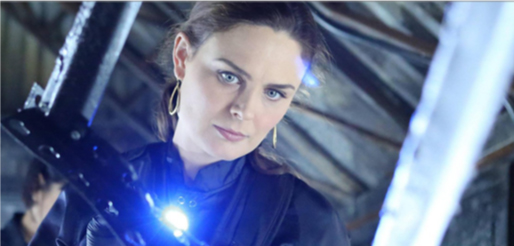
Showing posts with label Bones. Show all posts
Friday, November 22, 2013
So What Did Margie Say About.....Bones: The Mystery in the Meat
The 11/22/13 Bones episode titled "The Mystery in the Meat" was based on a person having been killed, placed in a meat grinder and added to stew which was then packaged in cans and sold to several locations, one being a school. My question is: how did such a long piece of clavicle bone survive the machine that 'ground things into uniform pieces'? And if this were so, how could the only mark on the bone produced by a sharp instrument be from the murder weapon and not the blades of the grinder?
I find it interesting as well that a whole eyeball would survive the process. It would seem that such a fragile part of the human body could not maintain its shape and inner fluid through such a process.
But the one thing that flustered me was the insinuation that arterial blood spray in the hair would withstand a dozen washes and still remain. Just ask someone who cleans crime scenes as a profession. There must be some cleaner that will wash it all away!
Tuesday, November 5, 2013
So What Did Margie Say About.....Bones: The Nazi on the Honeymoon
In the 11/4/13 Bones episode titled "The Nazi on the Honeymoon" both Forensic experts said that visiting the springs was not a good idea because they contain wild boar fecal matter.
This takes me back about two decades when one of my job duties was to test the public swimming pools and the water parks for bacteria. Boy, the things that grew in some of those waters!!
Now I know that thousands of people have played in the waters and very few have gotten deathly ill. So the adage that ignorance is bliss really applies here.
Studies have been done that indicate with all the antibacterial soaps and lotions that we are becoming our own worst enemy when it come to battling germs and bacteria. We can't build up a tolerance to such germs and bacteria without exposure to them.
Still, to this day, I have a hard time getting all those overrun petri dishes out of my mind when it comes to the inviting clear waters.
Monday, October 14, 2013
What Did Margie Say About....Bones: The Lady on the List
The 10/14/13 Bones episode titled "The Lady on the List" brought about a few points of discussion.
I am not aware of the Smithsonian having a veterinarian on staff to be able to capture and care for a wild hawk. Amazingly Dr. Saroyan drew blood from the bird without issue for analysis. It is true that animals feast on the remains and that information can be obtained from what they regurgitate or defecate but I doubt that an agency would care for the rodent, bird, or mammal with as much care as was taken tonight.
Another issue is with the removal of the face like a Halloween mask. What happened to all the muscles and tendons and such holding the face on the skull? I have never seen anyone just "lift" the face without the use of a scalpel to cut it away.
The last issue is with the ear wax. I am not discounting that there is a gold mine of information in the wax but I have never seen it analyzed outside of a television show. I doubt also that a neat little ball could be obtained from the remains as was depicted tonight.
Bones and Booth were not the only ones 'repelling' tonight.
Monday, October 7, 2013
So What Did Margie Say About....Bones: The Sense in the Sacrifice
The 10/7/13 episode of Bones titled "The Sense in the Sacrifice" reminded me of the short story The Gift of the Magi.
The difference here is that Bones and Booth dealt with their 'ethical dilemma' by the willingness for each to be the one to kill Christopher Pelant. Even though they stared evil directly in the eye, it was not in either one of their personalities to just murder someone without immediate provocation. But because they felt that if they didn't do it, the other would be hurt, they independently decided to take care of it.
Even though it is a bit far fetched to believe that a forensic anthropologist would be placed in this emotional position, I find it more believable than Pelant slicing a body in the time that was portrayed. Especially when you compare his action to a team of people in a forensic lab who needed all their talents and a good amount of time to accomplish the same task.
Great drama but stretching realism.
Monday, September 30, 2013
So What Did Margie Say About.....Bones: El Carnicero en el Coche
The 9/30/13 Bones episode titled "El Carnicero en el Coche" made me smile when there was a burst of bloodspatter on the interior windshield after a blast of rounds from an automatic weapon killed the driver. It did not match the two bullet holes with a small amount of blood flow from facial wounds when the victim was viewed. The victim also was wearing a wool cap which would have contained a lot of the 'burst' of spatter. I also don't think that an automatic spray of gunfire would only result in two facial wounds. What a terrible shot the shooter was if this is so. I would imagine that an automatic weapon with the firepower displayed would create a great deal of damage if just aimed in a general direction. It sure did a lot of damage to the glass and body of the vehicle!
I did appreciate the reenactment reference the yaw of the bullet to answer the question as to why there were two entry wounds but no exit wounds in the initial victim. The beveling of the skull bone was mentioned. Usually there is a conical shape which indicates which way the projectile is traveling. Some wounds are more difficult to determine if entry or exit but within a series of examinations such as the underlying bone beveling; the underneath damage of the injury skin; the tearing of the skin surrounding the injury; and even potential reenactments, the wounds are usually determined correctly.
Interesting show tonight, I am very happy that original episodes are back!
Tuesday, May 21, 2013
So What Did Margie Say...Goodbye Bones Hello Motive
It would appear that our Monday nights of Bones is over, at least for awhile. So I switched channels and watched the 5/20/13 sneak preview episode of "Motive" with the title 'Creeping Tom'.
There were a lot of references to psychological profiling. Detective Angie Flynn suggested that the creeping behavior (basically breaking and entering while leaving the word creepers behind) suggested someone who breaks into houses for the thrill of it because they are bored. She felt that the intruder was testing authority. On these bases she surmised that they were looking for a teenager.
It also came to light that creepers went in basically to nab a souvenir. When learning about criminal behavior analysis, there is a difference between a souvenir and a trophy. The way it was explained to me is that when you go to Disney World you buy a set of mouse ears as a souvenir. You appreciate them for awhile but right now you have no earthly idea where they are. On the other hand, if you earn a trophy, it is important to you and probably prominently displayed. You know exactly where it is. It's on the mantle or in a case. It is cared for and dusted and polished and treasured. Much more significant than a souvenir.
Anyway, back to behavior. It wasn't limited to human behavior. The calmness of the dog with the intruder was a big red flag that the dog was familiar with and even liked the perpetrator.
Leave it to man's best friend to be the deal breaker in the case. Go animals!!
Tuesday, May 14, 2013
So What Did Margie Say About...the CSI approach
Because there was no Bones episode on 5/13/13 I'd like to talk about how crime scene investigators approach a crime scene utilizing observation and perception.
Investigators should record their observations using their five senses: what they see, hear, feel, smell, and, to some extent, taste. A heavy sulfur atmosphere will combine with smell and give a hint of a twang taste. Lots of fresh liquid blood will smell and give a slight taste of iron.
I am not saying that one actually taste these things by placing something in your mouth. If you just open your mouth and breathe the air you can get the "sense" of taste when nothing blocks your smell. Some people use something in their nose to block smells but this practice may also mean that you may miss some information.
Obviously one records what they see but sometimes what you feel or hear is important too: Is it a cold environment? Is it humid? Is the wind blowing? Is the heat or air conditioner on and working? Do you hear engines or machinery? Is there water dripping in the scene? Is the body warm to the touch?
Do you smell anything? Is the smell common to the area? Is the body in a state of decomposition?
These observations are altered by your perception. Depending on your training, your life experience, and your background on the job, you may perceive things differently from someone else with a different history.
I have heard the tale of a law enforcement agent and a fireman at the scene of a homicide followed by an arson. The law enforcement agent gravitated toward the evidence of a cartridge case located on the floor. The arson investigator gravitated toward the book of matches next to the cartridge case. Same scene, same area but a different point of focus because of their backgrounds and interests.
This is why at the end of a crime scene response, it is advisable to get what is called a "fresh set of eyes" to reevaluate the scene. One reason is that they will have a different perspective and may find something that the original investigator did not focus on. The other reason is that after many hours on the scene, you are tired and a fresh viewpoint will help to assure that the best job was done.
Tuesday, May 7, 2013
So What Did Margie Say About...Bones/The Diamond in the Rough
The 5/6/13 repeat Bones episode titled "The Diamond in the Rough" showed Brennan using a chemical test to determine the presence of lead acetate in a ballroom dancers costume.
Sodium Rhodizonate is a chemical test used in forensic work, specifically in reference to firearms, to determine the presence of lead in many forms. The gaseous vapors, the particulate, and any bullet lead wipe determine that a shot was fired and may all help to distinguish a muzzle to target distance in shooting cases.
The further the distance the muzzle of a gun is away from the object shot (the target) the larger the circumference of the circle of gas and particles. There is a distance where these drop off and are no longer visible. A comparison of the pattern size and distribution will determine a range of distance if it within the range where this information is captured.
The lead wipe will tell you that it is a bullet hole.
Nitrites are also determined through a chemical test called the Griess test. These patterns, which are created by unburned or partially burned smokeless powder, also help to determine muzzle to target distance.
Speaking of distances, I think I will keep mine in reference to comment on the dancing of Bones and Booth.
Tuesday, April 30, 2013
So What Did Margie Say About....Bones, The Secret in the Siege
The 4/29/13 Bones episode titled "The Secret in the Siege" began with Booth saying that if the victim was shot at least eleven times then it would be easy to classify the case as a homicide.
The investigation of a death should always take the approach of being worked as a homicide just to be completely thorough. Usually it is a combination of law enforcement and the medical examiner investigations which classify a death investigation as to the manner of death. It could be a homicide, a suicide, a natural death, an accidental death, or a death that is undetermined.
A cause of death is considered the reason that the body ceased to function. Examples are blood loss, organ failure, and/or suffocation.
The method could be determined to be a gun shot, a stabbing, strangulation, disease, drowning, etc.
On the surface it would seem to be an easy thing to figure out and for the most part the situation is obvious. But the reason every death should have the investigation proceed like a homicide is because you are never sure what twists and turns or information will develop along the way. Something that originally may appear as a suicide may actually be a homicide or something that may appear as a homicide may be accidental.
This episode clearly dealt with the homicide aspects of investigations and leaned heavily on the psychological twists and turns rather than the hard science and evidence. I guess that would fall under: motive.
Tuesday, April 23, 2013
So What Did Margie Say About...Bones, oops The Following
Sorry folks but I was at a meeting on 4/22/13 and didn't make it home in time to catch Bones but I did watch "The Following" episode titled 'The End is Near'. Watching all the stabbings and shootings made me consider the importance of knowing about injuries and trauma.
Being a bloodstain pattern analyst, it becomes important to have an understanding of what injuries may cause what type of blood loss and what injuries may immobilize the victim.
If the injury is caused by a sharp object, one should ask: is the injury wider than it is deep? Is there a hilt mark bruise? Did the wound have clean edges or ragged edges? Was an artery or vein cut? Did the injury cross the body's Langer Lines (lines of cleavage which will determine if the skin remains together or if the wounds are gaping wounds)? Are major organs cut? Have bones been nicked? Has the body gone into shock? What is the activity and/or adrenalin level of the victim?
It seemed amazing to me that the several people who were stabbed in the abdomen appeared to die immediately. That is with the exception of one of the main characters. Joe received a similar type knife stabbing wound yet was mobile and relatively coherent. He also received an additional stab wound in the existing area of the injury with a fork and did not suffer the same fate as the others but remained alive and kicking.
Actually I would believe the lingering of Joe over the "drop dead" drama of the others. I once saw the aftermath of an eight year old girl who rode her bicycle into a plate glass window and suffered a deep severe cut to the throat from the broken glass. She continued to ride her bike several blocks to get to her grandmother's house before she collapsed dead in the front yard. No one would have believed she could have lived that long with that drastic of an injury much less participated in such action as riding a bike.
The body is an amazing creation. It is durable and unpredictable. But so is the mind and the psyche. Police Officers have been known to die from nonfatal injuries because of their mindset of having seen so many injuries and death during the course of their careers. They can't believe it when it happens to them and something in their make up just gives up. Others suffer injuries that should be immediately fatal but survive to live a long life.
I'm not even going to get into the gun shot wounds......
Tuesday, April 16, 2013
So What Did Margie Say About...Bones: The Party in the Pants
The
4/15/13 Bones episode titled "The Party in the Pants" used an abandoned
building about to be demolished as the "dump site". A dump site is as
varied as the perpetrator.
Their usefulness is usually for one of two purposes: to destroy
evidence and/or identity and hide the victim or to protect the victim so
that the killer can visit, usually on the anniversary of the death.
A dump site may be out in the woods where the body is buried or
covered with leaves and branches. More respect usually requires that
the victim is covered by rocks or stones. There is more opportunity to
recover evidence of the crime when the body is buried. It is more
protected from animal activity and environmental conditions.
The dump site may be a body of water. The victims may be tied down
with weights such as rocks or cement. The body may be contained in a
barrel or a 5 gallon drum or a suit case. Usually, once decomposition
occurs and gases are generated the body in a container will cause it to
float. If it's tied down and rotting occurs, then the weights are
loosened and the body floats.
The simple dump is in the dumpster hoping that the body ends up in a
landfill. Once the body is dumped in tons of trash, it is difficult to
find. The usual indicators like smell or vegetation or overhead birds
flying or bugs are commonplace in all the garbage.
Regardless of where the body is located, it is important to
remember that it is really the remains of a victim and all attempts must
be made to find the body or the evidence that remains.
Let's all remember those involved in the trauma and send good thoughts out to those in Boston.
Tuesday, April 9, 2013
So What Did Margie Say About...Bones: The Partners In The Divorce
The 4/8/13 repeat episode of Bones titled "The Partners in the Divorce" begins with Hodges finding 'blue blow flies'.
Entomology is a wonderful help to determine the PMI (post mortem interval) or the time since death.
There are tens of thousands of species of flies and it is important in Forensics what each one is attracted to. Some like fruit, some like defecation, some like putrification, etc.
The female blue blow fly smells the cadaverine, a gas released upon death, within minutes of its' release and can detect it within miles.
Flies don't have teeth so they use their tongues to suck the juices which is why they like the soft tissue areas or orifices like the mouth, nose, eyes, or wounds.
Not only do they feast but this is a great place for them to lay hundreds of eggs. The eggs hatch and become larva or what we normally call maggots. The larva can grow many times their original size and at the same time reduce the body mass of the food source (aka: victim).
Once the larva grow several stages (instars) they crawl to a dark quiet place to become pupa. They harden and look like brown or wild rice. They can be within feet of the body and in the dirt or folds of clothing. The next life cycle stage is that of the adult fly.
It is important for forensic entomologists to capture as many of the different stages of the fly that they can. They watch their captures through their stages in conjunction with the temperature of the scene to determine 'degree days'. This can give them a fairly accurate PMI.
Don't let it "bug" you, this is a great thing. The different species can also determine the travel path of some vegetative drugs and whether or not a victim may have been moved from one location to another.
Tuesday, April 2, 2013
So What Did Margie Say About...Bones, Maiden in the Mushrooms
The 4/1/13 episode of Bones titled "Maiden in the Mushrooms" reminds me that not all evidence is physical. Sometimes you can get powerful information from the psychological evidence displayed at a scene.
Crime scene profilers will tell you that there are tells at a scene that will give you insight into the perpetrator's mindset. For instance, a burglary where the lower level window screen is removed or cut into and the only room disturbed is that of a child and the only thing taken is change from a piggy bank, this is more than likely the work of a neighborhood kid.
This episode begins with a psychological profile of the victim buried face down. This is similar I suppose to a victim whose face is covered with a towel or an article of clothing. This particular action establishes remorse. It doesn't mean that the killer wouldn't do the deed again if given the chance, only that they knew the victim or had some sort of bond with them and a small part of them senses regret or remorse.
A second concept was the clothes and shoes of the victim. Obviously they belonged to someone who wanted to present as high class but the clothes were hand altered and the shoes didn't fit. Therefore they did not belong to the rich and famous, only someone who wanted to appear so.
There is also an insight into the mind of someone who would not report taunting and stalking by someone they had a restraining order out on.
Sweets made the statement that the suspects action were impulsive obsessive, not calculated and meticulous.
Speaking of obsessive, there is the behavior of Bones in regards to the biting incident of Christine. I'd say that it bordered somewhere on the verge of delusions of grandeur in that her daughter was perfect, or at least extremely above normal.
Personalities can leave tales at the scene and that's no April foolin'.
Tuesday, March 26, 2013
So What Did Margie Say About...Bones, the Blood from the Stones
I knowingly smiled at the 3/25/13 episode of Bones titled "The Blood From the Stones.
It is truly amazing what the presence of a camera will do and how different people's reaction to being filmed will range.
I don't know if it is inherent personality traits or upbringing or life experiences or a combination of all of these.
But just like the characters in tonight's episode, there are so many faces before the prying lens.
Some people are totally unassuming and just ignore the camera like it isn't even there. Others are totally star struck and stare directly at the camera like it has hypnotic capabilities. There are those that fancy themselves born stars and parade around in a peacock prance preening to show the world their abilities. Some are comedians, some are hostile, some are neutral, and others are cold and avoid the eye of the lens.
Regardless of the reaction, I have always wondered what truth there is in the final outcome. I guess that is the beauty of editing. As it turns out, hours of footage usually turns into mere minutes of background with either subtitles or someone else narrating. Gotta love Hollywood!!
Tuesday, March 19, 2013
So What Did Margie Say About...Bones "The Doom in the Gloom"
The 3/18/13 episode of Bones titled "The Doom in the Gloom" begins basically with an incinerated body.
These definitely provide forensic challenges. The identification
can't rely on a visual exam obviously. Facial features are
indistinguishable, tattoos are gone, and height and weight may
be difficult to determine.
Burn bodies are found in what is called a pugilistic attitude. A
pugilist is a boxer and when the extreme heat evaporates fluid from the
muscles, they draw up the legs and arms. The upper body position result
looks like a boxer in their stance with arms drawn up.
Sometimes the heat is so intense the brain basically boils and
explodes which causes skull fractures and damage. An extensive
examination is necessary to determine if the damage is done from the
outside in (blunt force trauma) or from the inside out (heat related
damage).
Going back to an identification of the fire victim, what to do if
visual characteristics are not available? If the fire is too intense
then it is highly likely that the fingers are absent or badly damaged.
Fingerprints therefore are not the option.
Nuclear DNA may not be an option either if the heat has damaged the tissues and muscles to such a degree that it has degraded.
Mitochondrial DNA may be the way to go as it is somewhat protected in the bone marrow or within the teeth.
If the teeth are still intact then they will provide a good source
for an identification. Dental records for comparison are invaluable.
Medical records will provide a source for comparison in regards to
prior surgeries which leave metal plates or screws in the body.
Sometimes these can be traced through serial numbers. So can most
breast implants but they don't hold up well in a fire.
Previous broken bones or some indications of a disease or injury may also help lead to an identification.
Along side the identification accomplishment, the other challenges
of retrieving evidence of what caused the fire, where it began, what may
have accelerated it, and what items can be salvaged are also areas that
keep the investigators busy in their job.
Tuesday, March 12, 2013
So What Did Margie Say About...Bones
The repeat episode of Bones titled "The Future in the Past" airing on 3/11/13 begins basically with an excavation. What it didn't demonstrate was the time and effort that this takes.
Booth did mention how a potential burial site is located. The foliage and soil is different from the surrounding area due to the disturbance of the soil to dig the grave and the fertilization of the vegetation from the decomposition of what is buried there.
What they did not show or talk about was the painstaking grid measurements; the constant documentation through photographs, notes, and sketches; the cautious digging inch by inch of the soil; and then the constant sifting of this soil to find the small traces left behind. This could include teeth, hair, buttons, zippers, fingernails, tiny fragments of bones, jewelry - the possibilities are endless.
Once something substantial like bone is located then the paint brushes come out and the tedious work truly begins. Nothing like a trowel or a shovel can be used to potentially damage such fragile evidence.
Also let's take into account the weather. Is it extremely hot? Or cold? Or raining heavily? Or snowing? How is the wind gusting?
Let's talk logistics: Do we have a tent available to protect the area? Do we have a staging area to keep the equipment clean? Do we have a clearing area to dump the sifted debris?
Let's ask: Is the ground frozen? Is it sandy? Is it clay? Is there a water level which may interfere with recovery?
Let's ask: Is it a rural area that makes it difficult to get equipment in the area? Is there a constant presence of news reporters? Have the trees and bushes overgrown the area making it difficult?
Let's ask: What about manpower? Do we have enough people to help carry buckets, and sift, and brush, and document? How many hours will this take and is overtime in the budget? Do we have the screens and tools readily available?
How nice it would be if things were as pristine and as simple as it was depicted in a few seconds of frame in tonight's episode.
Tuesday, March 5, 2013
So What Did Margie Say About...
I am not going to focus on forensics or anthropology in reference to the 3/4/13 Bones episode titled "The Survivor in the Soap". I am not going to discuss the politics of civil war atrocities or the scourge of children soldiers.
Rather I wish to take a moment and give acknowledgement to those professionals who give up their routine days and evenings. Those who give up their dinner reservations and other appointments or commitments for the sake of their professions. Those who give up birthday parties, recitals, holiday dinners, and all those other activities that create a 'normal' life.
I wish to thank those who are always waiting for the tone of a telephone ring knowing full well that their time and thoughts will be taken away from their routine. Just like Cam gave up dinner with her love interest. Duty called.
And let's look at Bones. Even while talking about vacation, her desire was to go to Paris to view catacombs and sewers. She is never far away from her calling. Even if some aren't as absorbed in their general professions there are cases that are constantly on ones' mind. They burrow way down deep and never leave your thoughts, even while away from work. The details and questions are always just below the surface.
I wish to not only express thanks to those professionals but also to their families and friends who just smile and understand and wait.
Tuesday, February 26, 2013
What Did Margie Say About...
The 2/25/13 Bones episode "The Fact in the Fiction" brought to light a few themes that I would like to talk about.
First, the FBI agent was squatting while taking photographs to document the crime scene. Although this is fine for supplemental photographs, the mainstay photographs should be at something called natural perspective. That is eye level when standing.
One of my partners was 6'5" tall. When he entered and viewed a scene, it was at quite a different viewpoint than my 5'4" height. He could see things without assistance at a higher level than I could. The first matter of business would be to document the scene as you would see it just walking in. Then you do a much more thorough search to locate things outside your limitations - those things high or low. That's when it's okay to squat or stand on something for your supplemental photographs. You want to be able to testify in court that your mainstay documentation photographs accurately depict the scene as you saw it. Document those first and then you can explain the other views due to your search.
Secondly, all investigators deal with post crime scene interference on occasion. The large aerator was more destructive potentially than average interference but things tend to happen. Well meaning family members, curious passersby, pets or wild animals, weather, first responders, medical personnel - all of these could alter the potential evidence. One must keep an open mind to explain the things that may not be in their "original" state. Or even better, to recognize those things in the first place.
And last, but not least, I was so thrilled that they dismissed the idea of bagging a head in plastic. This sounds basic but many don't think about the idea of condensation as mentioned in the episode. This lends itself to mold and bacterial infestation. Just think about buying a nice piece of steak and then leaving it sealed in plastic on the kitchen counter for a week. Would you then go ahead and eat that? I don't think so. The same degrading that occurs in the meat will occur in the biological evidence. The bottom line is always to maintain the integrity of the evidence and preserve it in the best condition possible.
Time travel, on the other hand, is a whole separate subject altogether.
Tuesday, February 19, 2013
So What Did Margie Say About...
Friend In Need Episode of Bones
The 2/18/13 Bones episode "The Friend in Need" brought to the forefront the age of technology. Digital Forensics or Multi-media evidence is fast becoming a powerful tool in crime fighting and investigation.
Even though someone deletes information, it may not be gone.
Or the idea that it is not deleted but shared on the Internet is a daily occurrence. Take for instance the many images displayed from the party. As many as 50 attendees with cell phones shared their images. And these images, good or bad, could be available for a long, long time.
Just watch the news and you will see the results of cell phones and surveillance cameras which document everywhere and all the time.
If you have just recently gotten a driver's license photograph, they ask you not to smile. This is to help them with facial recognition.
In the episode, they kept returning to the on-line images to follow the participants in the story line. Not only did this digital documented information help them determine a time line of events but it also helped to establish identities which led them to a rapist and a killer.
As they say, a picture is worth a thousand words.
Tuesday, February 12, 2013
So What Did Margie Say About...
The 2/11/13 Bones episode titled "The Shot in the Dark" was a unique one. I seriously doubt that frozen blood bullets will soon become the wave of weaponry any time soon.
However, there was a statement in the episode that struck a cord with me. It was stated that 'they never test the blood in a pool near the body'. Unfortunately this is often truer than not. The rule of thumb at crime scene is, or at least should be: when in doubt, collect it. It goes along with the theme that it is always better to have it and not need it than to need it but not have it.
Investigation theories may take several twists and turns during the investigation and what could be considered evidence at one point in time may not necessarily be pivotal but something taken on a second thought may actually be one of the most important pieces of information that makes or breaks a case.
Over the many years of bloodstain analysis, unfortunately I have inherited several cases that initially were simply considered a suicide but years later more information pointed toward a potential homicide. If all cases were worked as if they were a homicide to begin with and all possible evidence collected initially then there is no harm, no foul. However, if the crime scene investigator becomes tunnel visioned and does the bare minimum because it is just considered a suicide...well you can see the potential problems.
Subscribe to:
Posts (Atom)